Here's what most hiring processes look like: someone glances at a resume, makes a judgment call, then schedules a quick phone screen. The recruiter asks a few questions, jots down some notes, and that's it. It's been the playbook for decades.
But what if I told you there's a different way? What if every candidate got asked the exact same questions, their answers got analyzed in real-time, and you had a detailed assessment—not just a gut feeling within hours of them applying?
That's what happens when AI conducts your first interview. And it's not just about speed (though that's nice). It's about getting structured, standardized output for every single candidate, automatically generated and ready for your team to act on. That's fundamentally different from resume screening, keyword matching, or a chat between a recruiter and an applicant.
Why Those 15-Minute Phone Screens Aren't Cutting It Anymore
Picture this: It's Tuesday afternoon. Your recruiter calls Candidate A. They have a nice conversation. Good energy. They mention they've led teams before. Recruiter jots down: "Sales background, seems smart, good culture fit."
Fast forward a week. A different recruiter calls Candidate B. The candidate is quieter. Less chatty. The recruiter writes: "Limited experience, but asks good questions."
Now your hiring manager is trying to compare them. But how? One recruiter's "seems smart" is someone else's "asks good questions." You're not comparing apples to apples you're comparing one person's impression to another person's impression, filtered through their mood that day, how much coffee they'd had, and whether they were rushing to the next meeting.
That's the core problem with unstructured phone screens. Here's what goes wrong:
Different questions for different people: Each recruiter has their own style. Some ask about leadership, others about problem-solving, others just make small talk. You end up learning different things about each candidate.
Bias creeps in everywhere: Maybe you pick up on someone's accent and unconsciously assume something about their background. Maybe someone's enthusiastic delivery makes you think they're smarter than they are. Maybe another candidate is nervous on the phone but would be great in the role.
Notes disappear: Recruiters write down a couple of bullet points. Two months later, your hiring manager asks what Candidate A said about handling conflict. The recruiter moved on to 20 other conversations. They can't remember.
Everything takes forever: Scheduling is a nightmare. Candidates have to find a slot. Recruiters have to find a slot. Then you need the hiring manager to give feedback. Then someone writes it up. What should take a day ends up taking a week.
Your best people are stuck in meetings: Your top recruiters, the ones who should be out finding talent and building relationships, are spending 4 hours a day on screening calls. That's time they can't spend on actual recruiting.
Resume parsing and keyword matching try to solve part of the problem, but they fall short too. A resume tells you what someone claims they did. It doesn't tell you how they actually think. It doesn't reveal how they handle pressure, or if they can communicate an idea clearly, or whether they're being honest about their impact. That only comes from a real conversation.
What Changes When AI Actually Interviews Your Candidates
Here's how it works: A candidate applies. Within minutes, they get a text or email with a link to a structured voice interview. They click it, answer 5 to 8 targeted questions tailored to the role, and hit submit. No scheduling required. No back-and-forth on calendar availability. Just 15 minutes of their time, whenever it's convenient for them.
Behind the scenes, the AI's doing something way more sophisticated than just recording audio. It's:
Listening carefully to what they say, Not just catching keywords, but understanding the depth of their answers, how they structure their thinking, and what they're actually skilled at.
Scoring against your job requirements — Communication, problem-solving, role-specific skills, cultural alignment. Each gets its own score based on what they actually demonstrated in the interview.
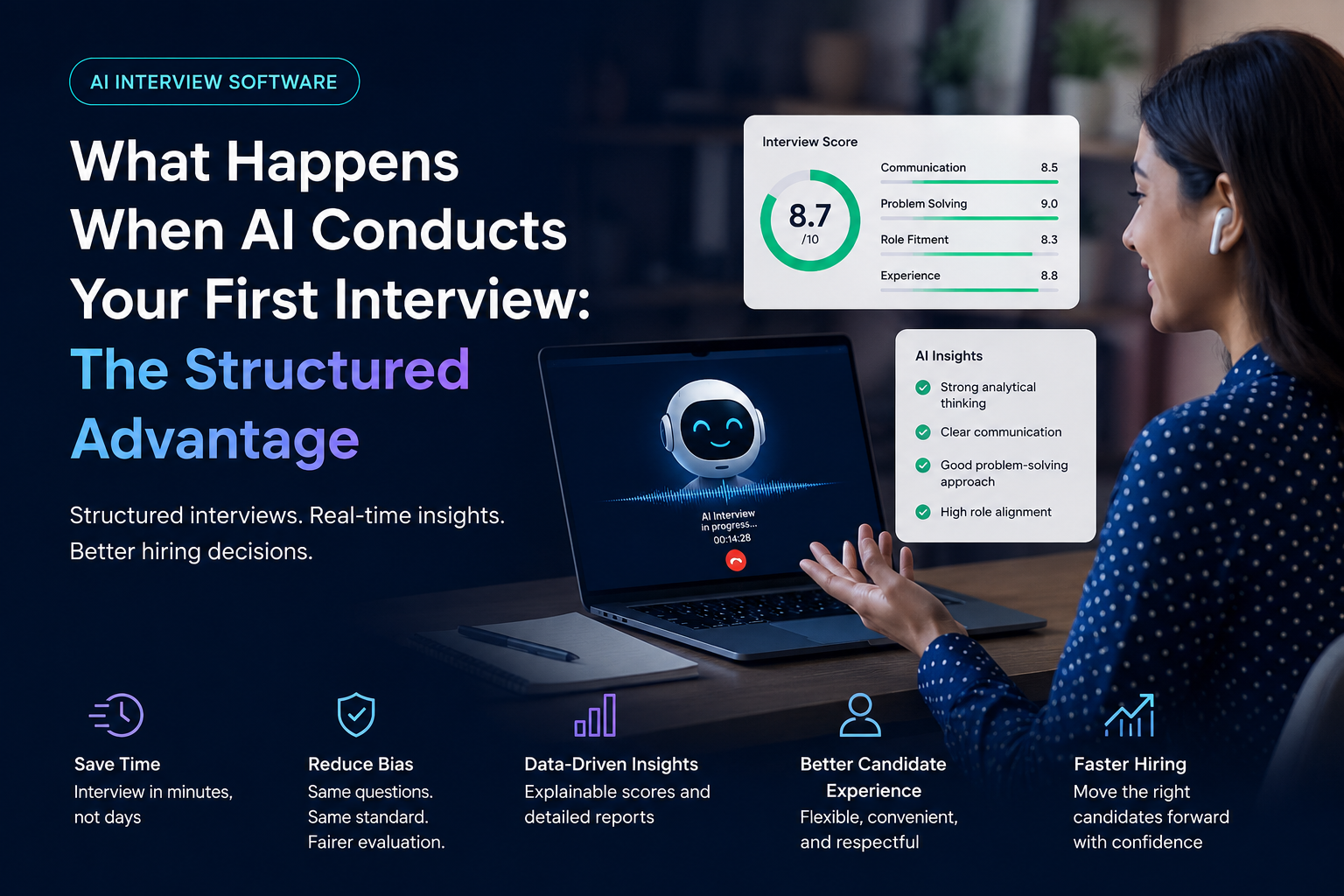
Creating a detailed report — Within a couple of hours, you get a full candidate profile with scores, a transcript, and reasoning behind each score. You can log in and see it instantly.
And here's the thing — every candidate gets the same exact experience. Same questions. Same scoring criteria. Same timeline. That's the magic.
Five Things That Shift Immediately
- Fair comparisons become possible
When Candidate A and Candidate B both answer the same questions, you can actually compare them. You're not weighing "seemed energetic" against "asked smart questions." You're looking at data. Did they identify the root cause of a problem? How many solutions did they propose? Could they walk you through a complex project? You have real answers, not impressions.
- You know why a candidate got a certain score
The AI doesn't just say "Candidate A scored 7.8 on problem-solving." It says: "Candidate A scored 7.8 because they identified the root cause, proposed two distinct solutions, and acknowledged trade-offs. We deducted points because they didn't back up their claims with metrics." That's a level of transparency that changes how hiring managers evaluate candidates. They can actually understand the reasoning, not just trust a gut call.
- Your pipeline moves faster
No scheduling friction means interviews happen immediately. You can assess 50 candidates in 48 hours instead of spending the next month trying to find time slots. And because you have structured data on all of them, you can spot patterns early. "Huh, all our top candidates nailed communication but struggled with technical depth." That insight lets you adjust your sourcing, update your job description, or rethink your interview questions before you're halfway through the funnel.
- Recruiters become strategists instead of gatekeepers
Your best recruiter stops spending 3 hours a day on phone screens and starts doing what they're actually good at: talking to candidates about career growth, understanding what they're looking for, and finding them roles that fit. Or they spend time coaching hiring managers on how to dig deeper with the assessment data they've got. Recruiting gets better and less exhausting.
- You get consistency without feeling robotic
Candidates actually appreciate it, too. They get to explain their thinking in their own way without worrying about a recruiter's mood or communication style affecting how their answer lands. And they get feedback faster—not a vague "we'll be in touch," but real data on how they performed.
Let's Make This Concrete
Say you're hiring for a sales development role. Two candidates apply on the same day.
The old way: You schedule one candidate's call for Tuesday. The other can't do Tuesday, so it's Thursday. First recruiter thinks the Tuesday person "has great energy." Second recruiter (different person) thinks the Thursday person "asks thoughtful questions." Hiring manager reviews notes weeks later and can't really tell who's stronger. You make a gut call. Hope it works out.
The AI way: Both candidates complete the same AI interview by end of day. Candidate A gets 8.2/10. Breakdown: Communication 8.5, Resilience 7.8, Discovery skills 8.9, Objection handling 7.6. The assessment notes they ask probing questions and stay calm under pressure, but they need work on negotiation frameworks.
Candidate B gets 7.1/10. Communication 7.2, Resilience 8.1, Discovery skills 6.8, Objection handling 6.5. Notes say they've got solid interpersonal instincts but take longer to bounce back from rejection and need coaching on structured discovery methods.
Your hiring manager reviews both assessments the next morning. She can see exactly what each person's good at and where they need development. She doesn't just know who to move forward—she knows what she'll work on with each person in their next conversation. That's a completely different level of informed decision-making.
How This Fits Into Your Whole System
Here's where it gets powerful: AI interviewing doesn't exist in a vacuum. When you layer it into a full recruitment automation platform, the benefits compound.
That structured data from the interview? It feeds directly into everything else. Candidates scoring 8.0 and above go straight to a hiring manager call—no additional screening. A 6.5 might go to a brief follow-up or coaching conversation before deciding. A 5.0 gets a polite decline with specific feedback so they know what to work on.
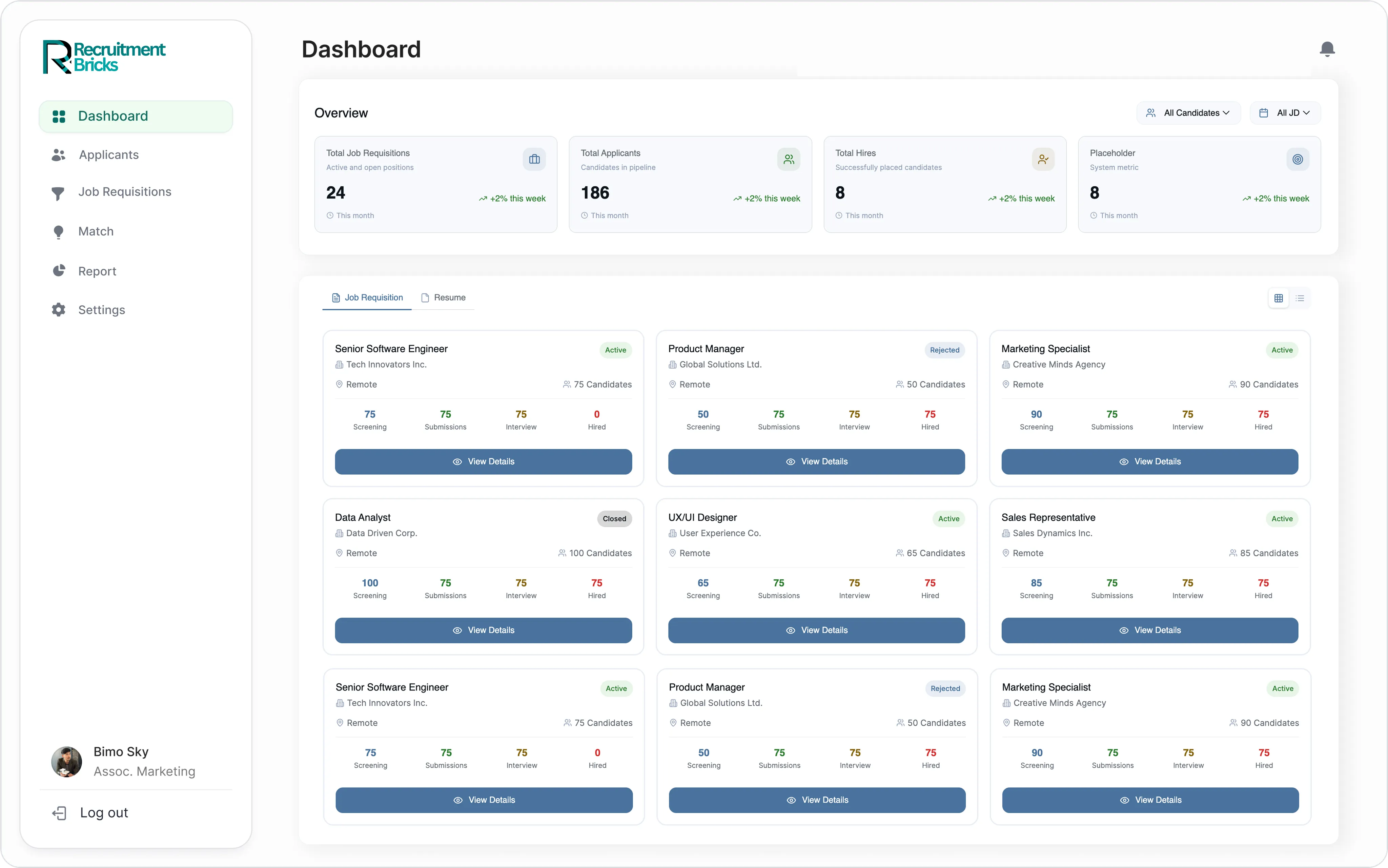
Your analytics dashboard shows you which job descriptions attract the strongest candidates. Which sourcing channels send the highest-quality applicants. Where people drop off in the funnel. Which interviews led to strong hires and which didn't.
And because everyone's being evaluated against the same criteria, bias—the unconscious kind that creeps into every hiring process—gets significantly smaller. You're not choosing who "feels" like the right fit. You're choosing based on demonstrated skills.
What This Actually Means for Your Team
In practice, here's what changes:
Time-to-hire drops significantly. You're not waiting for callbacks and interview coordination. It just happens faster.
The quality of people you hire improves. You're making decisions based on what candidates actually demonstrated, not on a phone screen feeling.
Your recruiters don't burn out. They spend their time on things that matter, not stuck on endless screening calls.
Hiring becomes more defensible. If anyone asks why you hired someone or passed on someone, you've got detailed data, not just "the recruiter had a good feeling about them."
The Real Difference
Look, this isn't just about AI being cool or new. The real shift is this: traditional hiring relies on the quality of individual interactions. Who called the candidate? Did they have time? Were they in a good mood? Did they ask the right questions?
AI interviewing removes the randomness. You're not betting on recruiter A versus recruiter B. You're running a consistent, repeatable process that treats every candidate fairly and gives you actual data to work with.
That structured output produced automatically, available immediately, comparable across your entire candidate pool is what makes AI interviewing fundamentally different from everything else you've tried.
If your current process still relies on scattered notes, recruiter gut feel, and hoping you found the right person, it's worth asking: what could change if you had real, structured intelligence about every candidate within hours of them applying?
Frequently Asked Questions:
Isn't AI interviewing kind of cold and impersonal for candidates?
Not really. Candidates actually often prefer it. They can do it on their own schedule, not trying to find a time that works for both of you. They're not nervous about a recruiter's reaction or worried about saying the wrong thing in real-time. And when it's done well, they appreciate getting fast feedback. The experience feels modern and professional, not like they're being screened by a computer.
How is this different from just recording a video interview?
Video interviews are passive; someone records themselves answering questions, and then a human has to watch and evaluate it. That takes time and still introduces subjectivity. AI interviewing is active: it listens, analyzes, scores, and generates a full assessment automatically. You get structured data, not just video to review.
Will this replace my recruiters?
No. The opposite, actually. It frees them up to do things AI can't do—like building relationships, negotiating offers, understanding what candidates really want in their next role. Screening calls? Those don't require human judgment. Strategy, coaching, relationship-building? That does.
How fast are we talking here?
Most AI interviews take 10 to 20 minutes depending on the role. Candidates usually complete them within 24 hours of getting the link. You've got structured assessments for your whole candidate pool within a day or two. Compare that to traditional phone screening—you're looking at weeks to get through everyone.
What if the AI makes a mistake in scoring?
The AI isn't making the decision—you are. It's providing data and reasoning, and you (or your hiring manager) reviews it. Think of it like a very thorough candidate summary instead of your recruiter's 3-bullet notes. You've got way more to work with, and nothing's automated away from human judgment.
Can you really assess someone's fit for a role through an AI interview?
For most roles, yes—especially for entry to mid-level positions. Senior hires might need more depth, which is why AI interviewing works best as part of your process, not the whole thing. It's amazing at screening and initial assessment. It's less good at nuanced cultural fit conversations. Use it where it's strong, and layer human judgment on top.
Does this reduce bias in hiring?
Significantly, yeah. When everyone answers the same questions and gets scored on the same criteria, a lot of unconscious bias falls away. No one's making assumptions based on someone's accent or communication style or how much they talk. It's more objective by design. Not perfectly objective—no process is—but much better than unstructured phone calls.
What happens to candidates who don't pass the AI interview?
They get thoughtful feedback, not silence. You can communicate specific areas they could strengthen for future applications or roles. Some candidates appreciate that more than a generic rejection. It's actually a better experience for them.
How do you customize AI interviews for different roles?
You set the questions and scoring criteria for each role. Sales roles gets different questions than engineering, which gets different questions than customer success. The process is standardized; the content is custom.
Is this actually saving us money?
Yes. Less recruiter time on screening, faster hiring, better quality hires who stay longer. The math works out. Plus, reduced bad hires (which are expensive) and reduced recruiter burnout (which is also expensive). ROI is usually clear within a few months.
RecruitmentBricks - Schedule a Demo