Hiring the right candidate has always been challenging. But with AI recruitment software now reshaping how organizations source, screen, and evaluate talent, the gap between efficient and inefficient hiring has never been wider. Companies that understand where artificial intelligence in recruitment adds real, measurable value are gaining a serious competitive edge. This blog explores the specific areas of the hiring lifecycle where AI-powered tools consistently outperform traditional approaches, helping HR teams move beyond the hype and unlock practical, lasting impact.
Key Takeaways
- AI recruitment software delivers the greatest value in candidate sourcing, screening automation, and pipeline decision-making.
- AI candidate sourcing surfaces qualified talent faster, including passive candidates that manual searches routinely miss.
- Intelligent applicant screening software standardizes evaluation, reduces bias, and allows recruiters to focus where human judgment matters most.
AI Candidate Sourcing: Finding the Right Talent at Scale
AI candidate sourcing enables recruiters to identify and rank qualified candidates across multiple channels at once, using job descriptions, resume data, and behavioral signals to surface the best matches quickly. Instead of spending hours on manual searches, recruitment teams receive a filtered, prioritized shortlist that reflects actual role requirements rather than surface-level keyword matches.
Modern AI recruitment software goes well beyond traditional keyword scanning. It interprets context, identifies transferable skills, and factors in career trajectory when evaluating fit. This means candidates are surfaced based on genuine alignment, not just resume formatting. Recruiters save significant time while improving the relevance of every shortlist they work from.
RecruitmentBricks takes this further through reverse resume matching, which maps open positions to internal candidates already within an organization. This ensures that external sourcing and internal mobility are managed within a single platform, reducing the risk of overlooking strong internal talent. For high-volume hiring teams, this kind of intelligent sourcing can dramatically reduce time-to-fill without compromising candidate quality.
Industry research published by LinkedIn Talent Solutions consistently highlights that AI-powered sourcing tools help recruitment teams identify stronger candidates in significantly less time compared to traditional methods. Organizations investing in AI candidate sourcing are not just moving faster. They are building more relevant, higher-quality pipelines from the start.
Intelligent Applicant Screening Software That Eliminates Guesswork
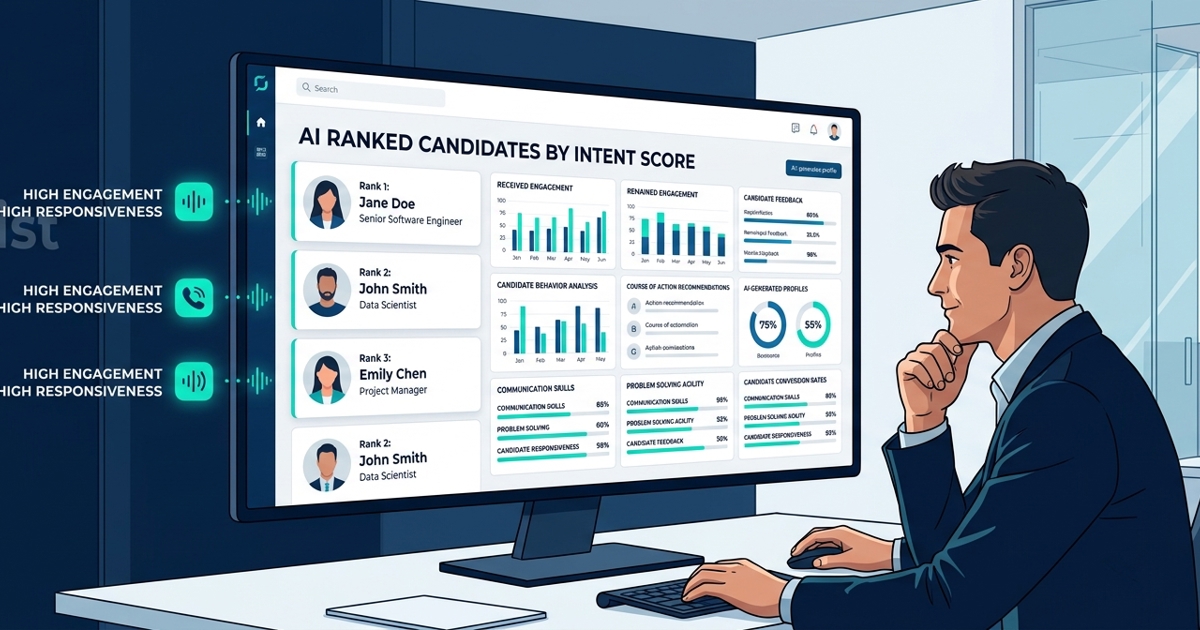
Intelligent applicant screening software replaces the time-consuming manual review process with automated, AI-driven evaluation that scores and ranks candidates based on defined criteria. This removes inconsistency from the screening stage, ensures every application is assessed against the same standard, and allows recruiters to focus attention on the most qualified candidates rather than the loudest resumes.
Manual resume screening is one of the most resource-intensive parts of the hiring process. In high-volume roles, reviewing hundreds of applications per day leads to fatigue, inconsistency, and a higher chance of overlooking genuinely strong candidates. Intelligent applicant screening software addresses this directly by automating the first-pass evaluation, scoring each application against the job description, and surfacing the profiles that best match defined requirements.
RecruitmentBricks enhances this stage further with its AI-powered VoiceBot, which conducts structured voice interviews and generates scoring based on candidate responses. This means the screening stage captures behavioral and communication signals that a resume cannot convey. Recruiters receive ranked candidates, complete with scoring rationale, before any direct conversation has taken place. You can explore the full scope of these capabilities on the features page.
This level of standardization also reduces unconscious bias in early-stage evaluation. Every candidate is measured against the same framework, making the screening process fairer and more defensible to hiring stakeholders.
Smarter Hiring Decisions Powered by Explainable AI
Artificial intelligence in recruitment replaces opinion-based evaluation with explainable, data-backed insights that give hiring teams a consistent framework for comparing candidates. Rather than relying entirely on individual recruiter judgment, an AI recruitment platform surfaces match scores, highlights skill gaps, and provides context for every recommendation, making the decision-making process more transparent and reproducible across the entire team.
One of the most persistent problems in traditional hiring is subjectivity. Two equally experienced recruiters can review the same candidate and reach entirely different conclusions. AI recruitment software solves this by generating explainable match scores between candidates and job descriptions, giving teams a shared, objective baseline for evaluation.
This does not remove human judgment from the process. It strengthens it. Recruiters and hiring managers can review AI-generated insights, challenge them where needed, and make well-informed decisions with greater confidence. Data-driven hiring practices are widely associated with higher retention rates and stronger long-term performance outcomes, with consistent hiring criteria reducing the likelihood of costly early attrition.
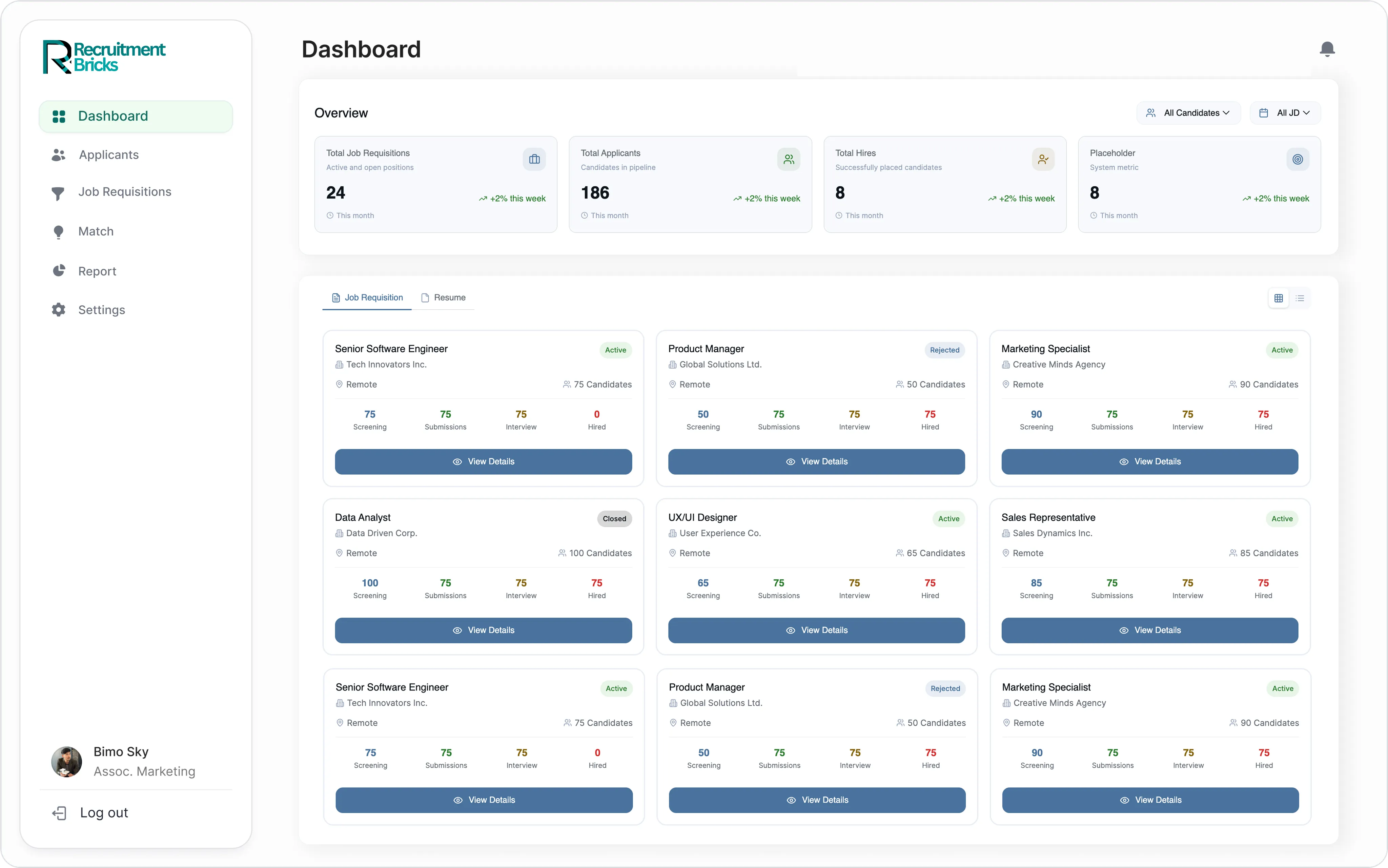
The action-enabled approach used by RecruitmentBricks takes this further by surfacing the "next best action" for every recruiter at every stage of the pipeline. Rather than leaving teams to interpret data independently, the platform guides what to do next. Real-time pipeline intelligence also helps hiring managers spot bottlenecks before they cause delays. Key decision-making advantages that AI recruitment platforms provide include:
- Explainable match scores between candidates and job descriptions
- Real-time pipeline health tracking across all open roles
- Automated alerts for stalled candidates or delayed review stages
- Consistent evaluation criteria applied across every hiring manager and department
Reducing Recruiter Workload with an AI Recruitment Platform
A well-built AI recruitment platform automates the administrative tasks that consume the most recruiter time, including scheduling, follow-ups, feedback collection, and candidate communication. By removing repetitive work from the recruiter's daily routine, the platform creates space for relationship-focused work where human skill is genuinely irreplaceable and has the greatest influence on hiring outcomes.
Recruiter burnout is a real and growing problem, particularly in high-volume hiring environments. When recruitment teams spend the majority of their time on coordination and data entry, they have little capacity left for meaningful candidate engagement or strategic thinking. An AI recruitment platform addresses this imbalance directly.
RecruitmentBricks automates several of the most time-consuming recruiter tasks. Interview scheduling, automated call recording, feedback nudges, and WhatsApp-based candidate follow-ups are all handled within the platform. This keeps candidates engaged between screening and interview stages without adding workload to the recruiter. The integrations page details how the platform connects with existing ATS, HRMS, and CRM systems, creating a seamless end-to-end workflow that removes friction at every stage.
RecruitmentBricks reports up to 60% faster time-to-hire for organizations using its platform. That result comes directly from reducing manual overhead at every point in the pipeline. When recruiters spend less time on coordination, they invest more energy in evaluating candidates, building relationships, and improving offer acceptance rates. The candidate experience also improves significantly when responses are faster and communication is consistent, which directly influences how top talent perceives an employer.
Choosing the Best AI Recruitment Tools for Your Organization
The best AI recruitment tools for any team depend on specific hiring challenges, volume, and the existing technology stack. A platform suited to a startup managing specialist hiring will look very different from one built for an enterprise running hundreds of concurrent roles across multiple regions, and understanding that distinction before making a purchase decision is critical.
Not every AI recruitment software is designed for every use case. When evaluating options, prioritize platforms that offer explainable AI rather than black-box scoring. Recruiters need to understand why a candidate was recommended, not simply that they were. Transparency in AI decision-making builds trust within the hiring team and ensures the tool is used thoughtfully rather than blindly accepted.
Modular platforms offer the most practical flexibility. Rather than adopting a large, complex system all at once, organizations can activate the features most relevant to their immediate bottlenecks and expand over time. RecruitmentBricks is built around exactly this philosophy, drawing on the Lego-brick concept of assembling only the capabilities you need. This approach makes it one of the best ai recruitment tools for organizations that want scalable, targeted AI adoption without a disruptive overhaul of existing processes.
Additional factors to evaluate when selecting an AI recruitment platform include:
- Integration compatibility with your current ATS and HRMS environment
- Quality and reach of candidate communication tools, including WhatsApp and email automation
- Availability of sourcing effectiveness dashboards and pipeline analytics
- Whether the platform supports both external hiring and internal talent mobility in one workflow
For a deeper look at how RecruitmentBricks aligns with different organizational hiring needs, visit the about us page to understand the platform's background, founding philosophy, and the team behind it.
Conclusion
AI recruitment software is no longer a future consideration. It is the present reality for organizations serious about hiring efficiently, consistently, and at scale. The areas where it delivers the most value are clear: intelligent sourcing, automated screening, data-backed decisions, reduced administrative burden, and scalable hiring operations built to grow with the business. The key is understanding your specific bottlenecks and choosing tools built to address them directly. Whether you are managing high-volume hiring or scaling a growing team, artificial intelligence in recruitment provides a measurable path forward. Request a demo with RecruitmentBricks to see exactly where it can make the biggest difference in your process.
FAQ
What is AI recruitment software?
AI recruitment software uses artificial intelligence to automate and enhance key hiring tasks, including candidate sourcing, resume screening, and interview scheduling. It helps recruitment teams reduce manual effort, work faster, and make more consistent, data-backed hiring decisions throughout the pipeline.
How does AI recruitment software speed up time-to-hire?
AI recruitment software accelerates hiring by automating resume parsing, candidate ranking, interview scheduling, and follow-up communications. Removing these manual bottlenecks at each stage helps recruitment teams move candidates through the pipeline faster while maintaining consistency and quality across open roles.
What is AI candidate sourcing and how does it work?
AI candidate sourcing uses algorithms to analyze job descriptions, resumes, and behavioral signals across multiple channels simultaneously. It ranks profiles by relevance and role fit, allowing recruitment teams to build stronger shortlists much faster than traditional manual sourcing methods allow.
How does intelligent applicant screening software reduce bias?
Intelligent applicant screening software evaluates every candidate against identical predefined criteria, removing subjectivity from the review process. Assessments are based on skills, experience, and structured scoring rather than personal judgment, making early-stage evaluations fairer and more consistent across all applicants.
What features should an AI recruitment platform include?
A strong AI recruitment platform should offer explainable match scoring, automated candidate communication, resume parsing, pipeline analytics, and ATS integration. Modular platforms that let teams activate only the features they need provide the most practical flexibility.
Can AI recruitment tools integrate with existing HR systems?
Most leading AI recruitment tools integrate with existing ATS, HRMS, and CRM platforms, ensuring a connected workflow. This eliminates the need to replace existing systems and allows teams to layer AI capabilities directly onto their current recruitment infrastructure without disruption.
Does artificial intelligence in recruitment replace human recruiters?
Artificial intelligence in recruitment is designed to support recruiters, not replace them. AI automates repetitive tasks like sourcing and screening while human professionals handle relationship building, candidate assessment, and final hiring decisions, where interpersonal judgment remains irreplaceable.
What skills do recruiters need to use AI recruitment platforms effectively?
Recruiters using AI recruitment platforms benefit most from skills in data interpretation, structured interviewing, and strategic pipeline management. Those exploring a career in AI-driven talent acquisition will find these competencies increasingly valuable as intelligent hiring tools become industry standard.
How does AI recruitment help with internal talent mobility?
AI recruitment platforms match open roles to internal candidates by analyzing skills, experience, and career trajectory within an existing workforce. This reverse resume matching helps organizations reduce external sourcing costs and retain talent through clear, data-backed pathways for internal advancement.
How can talent acquisition leaders stay current with AI recruitment trends?
Following HR technology conferences and recruitment industry events is one of the most effective ways for talent acquisition leaders to benchmark emerging tools, hear from practitioners, and stay informed about developments in artificial intelligence in recruitment.