The recruitment landscape has changed dramatically over the past decade. Hiring teams today must process larger applicant volumes, compete for specialized talent, reduce time-to-hire, and deliver exceptional candidate experiences. Yet many organizations still rely on legacy applicant tracking software that was designed primarily to organize resumes rather than optimize hiring outcomes.
This shift in hiring complexity is driving rapid adoption of the modern AI recruiting platform. Unlike traditional systems, AI-powered recruitment technology actively supports recruiters through intelligent candidate screening, automated engagement, predictive analytics, and real-time hiring insights.
According to LinkedIn Talent Solutions, finding qualified candidates remains one of the biggest challenges for talent acquisition teams. Organizations that continue to depend solely on legacy ATS systems often struggle to keep pace with modern hiring demands.
This guide explores how an AI recruiting platform compares to traditional ATS technology and why forward-thinking HR leaders are embracing artificial intelligence in recruitment to build faster, smarter, and more scalable hiring operations.
Key Takeaways
- An AI recruiting platform goes beyond application tracking by automating screening, engagement, and candidate evaluation.
- Traditional applicant tracking software helps organize applicants but lacks intelligent hiring capabilities.
- Artificial intelligence in recruitment improves hiring speed, recruiter productivity, and candidate quality.
- Modern applicant tracking system ai solutions provide real-time insights and predictive hiring intelligence.
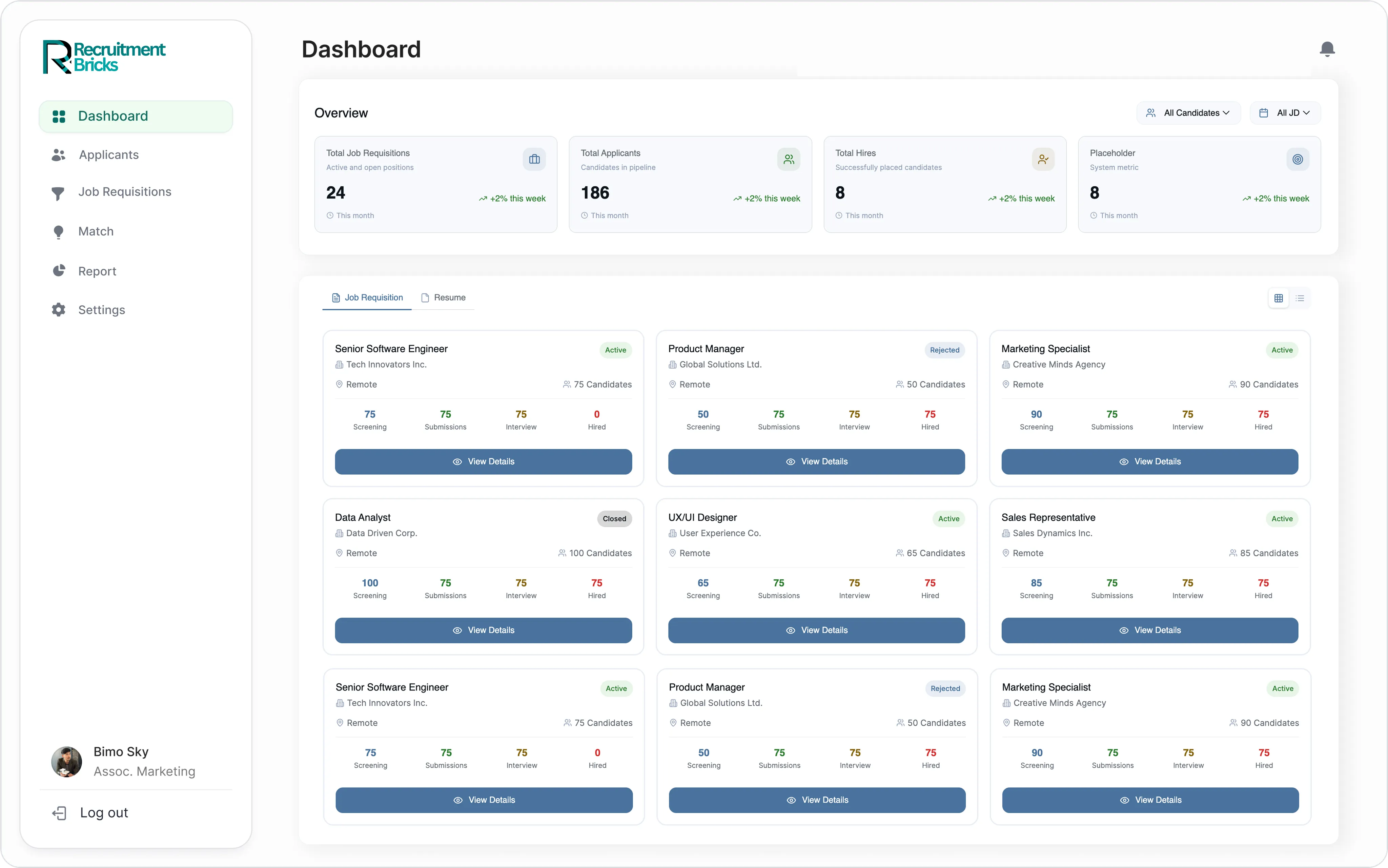
- RecruitmentBricks combines AI screening, VoiceBot interviews, candidate engagement, and analytics within a unified recruitment ecosystem.
Why Legacy Applicant Tracking Software Is Falling Behind
Traditional applicant tracking software was created to digitize candidate records and simplify application management. While this represented a major advancement at the time, recruitment challenges have evolved significantly.
Today's recruiters must:
- Manage high application volumes
- Engage candidates quickly
- Reduce hiring bottlenecks
- Improve candidate quality
- Support data-driven hiring decisions
Most legacy ATS platforms continue to function primarily as digital filing systems. They store applications efficiently but provide limited support for candidate evaluation, engagement, and prioritization.
As hiring competition increases, organizations require technology that actively assists recruiters rather than simply managing data.
Research from LinkedIn Talent Solutions shows that finding qualified talent remains one of the most persistent recruitment challenges. Traditional ATS platforms often lack the intelligence needed to address this challenge effectively.
What Makes an AI Recruiting Platform Different?
An AI recruiting platform transforms recruitment from a reactive administrative process into a proactive, intelligence-driven operation.
Rather than simply storing candidate information, AI-powered platforms analyze data, identify opportunities, and automate repetitive tasks that slow recruitment teams down.
AI-Powered Resume Screening and Matching
Resume review is one of the most time-consuming tasks in recruitment.
Modern AI-powered systems automatically:
- Parse resumes
- Analyze job descriptions
- Evaluate candidate fit
- Generate explainable match scores
- Rank applicants in real time
This enables recruiters to focus on qualified candidates rather than manually reviewing hundreds of applications.
Unlike traditional applicant tracking software, an AI-powered system actively helps recruiters identify top talent faster.
Voice AI Screening and Pre-Qualification
Many organizations spend significant recruiter hours conducting initial screening calls.
RecruitmentBricks addresses this challenge through VoiceBot-powered interviews that:
- Generate role-specific questions
- Conduct structured pre-screening conversations
- Evaluate candidate responses
- Automatically score applicants
- Advance qualified candidates to the next stage
This allows recruitment teams to focus on strategic hiring activities instead of repetitive screening tasks.
Intelligent Candidate Ranking
A modern AI recruiting platform evaluates candidates using multiple data points rather than relying solely on keyword matching.
Evaluation criteria may include:
- Skills alignment
- Relevant experience
- Education
- Career progression
- Industry expertise
This approach improves shortlist quality and reduces the risk of overlooking qualified candidates.
AI Recruiting Platform vs Applicant Tracking Software
While traditional applicant tracking software and modern AI recruiting platforms both support recruitment operations, their capabilities differ significantly.
Legacy Applicant Tracking Software
Traditional applicant tracking software is designed primarily to:
- Store candidate information
- Track applications through hiring stages
- Manage recruiter workflows
- Maintain recruitment records
- Generate basic hiring reports
These systems help recruiters stay organized, but they often require significant manual effort for candidate evaluation, communication, and decision-making.
Modern AI Recruiting Platform
A modern AI recruiting platform goes beyond candidate management by actively supporting hiring decisions through automation and intelligence.
Key capabilities include:
- AI-powered resume screening
- Explainable candidate match scores
- Automated candidate engagement
- VoiceBot-driven pre-screening interviews
- Predictive recruitment analytics
- Internal talent matching
- Recruitment workflow automation
- Real-time hiring insights
Rather than functioning solely as a candidate database, an AI recruiting platform acts as an intelligent hiring assistant that helps recruiters identify, engage, and hire qualified talent faster.
Why HR Leaders Are Making the Switch
As hiring volumes increase and competition for skilled talent intensifies, organizations need technology that can do more than track applications.
HR leaders are increasingly replacing legacy applicant tracking software with AI-powered recruitment platforms because they deliver:
- Faster time-to-hire
- Improved recruiter productivity
- Better candidate experiences
- Higher-quality shortlists
- More consistent hiring decisions
- Greater recruitment visibility
This shift reflects the growing role of artificial intelligence in recruitment and the need for hiring technology that actively contributes to business outcomes.
How Artificial Intelligence in Recruitment Improves Hiring Outcomes
The adoption of artificial intelligence in recruitment continues to accelerate because organizations are seeing measurable improvements across key hiring metrics.
Faster Time-to-Hire
Manual recruitment processes create delays at multiple stages of the hiring funnel.
AI helps accelerate:
- Resume screening
- Candidate shortlisting
- Interview scheduling
- Candidate communication
- Hiring approvals
Organizations using intelligent recruitment automation frequently report substantial reductions in hiring cycle times.
Better Candidate Quality
One of the primary advantages of artificial intelligence in recruitment is improved candidate matching.
By evaluating multiple factors simultaneously, AI helps recruiters identify applicants who align closely with job requirements and organizational needs.
This results in stronger shortlists and improved hiring outcomes.
Improved Recruiter Productivity
Administrative tasks often consume a large portion of recruiter capacity.
AI automation reduces time spent on:
- Resume reviews
- Status updates
- Scheduling coordination
- Candidate follow-ups
This enables recruiters to focus on relationship-building and strategic hiring initiatives.
Closing the Candidate Engagement Gap
Candidate engagement is often where traditional recruitment systems fall short.
Many applicants receive little communication after applying, leading to frustration and increased drop-off rates.
Automated Candidate Communication
A modern AI recruiting platform supports consistent candidate engagement through:
- Instant responses
- Automated reminders
- Interview scheduling
- Status updates
- Follow-up communications
RecruitmentBricks leverages WhatsApp-powered engagement workflows to help organizations maintain communication throughout the hiring process.
Reducing Candidate Drop-Off
Candidates frequently withdraw from recruitment processes when communication is inconsistent or delayed.
Automated engagement helps maintain momentum, improve candidate experience, and reduce pipeline leakage.
This represents a significant advantage over many traditional ats for recruiters that provide limited engagement functionality.
Applicant Tracking System AI: Beyond Candidate Management
The evolution toward applicant tracking system ai technology represents a fundamental shift in recruitment software.
Traditional systems manage candidate data.
AI-powered systems actively support hiring decisions.
A modern applicant tracking system ai can:
- Recommend top candidates
- Prioritize recruitment actions
- Identify hiring bottlenecks
- Generate recruitment insights
- Improve hiring efficiency
This transforms recruitment technology from a passive database into an intelligent hiring assistant.
As organizations pursue digital transformation initiatives, applicant tracking system ai capabilities are becoming increasingly important for talent acquisition success.
Internal Talent Mobility and Reverse Resume Matching
Many organizations overlook existing talent when filling new positions.
This creates unnecessary sourcing costs and missed development opportunities.
Discovering Internal Talent Automatically
Modern AI platforms support internal mobility through reverse resume matching.
When new roles become available, the system can automatically identify employees whose skills and experience align with position requirements.
This allows organizations to:
- Reduce hiring costs
- Improve retention
- Accelerate hiring timelines
- Support career development
Building Skills-Based Hiring Strategies
Skills-based hiring is becoming a priority for many organizations.
AI-powered talent matching helps recruiters identify transferable skills and uncover opportunities that may not be visible through traditional recruitment processes.
This capability extends the value of artificial intelligence in recruitment beyond external hiring and into workforce development.
Integrating AI Recruitment Software with Existing HR Technology
One of the biggest concerns organizations have when evaluating AI-powered hiring technology is implementation complexity.
Fortunately, modern ai recruitment software is designed to integrate with existing HR ecosystems.
Organizations can connect AI capabilities to:
- ATS platforms
- HRMS systems
- CRM platforms
- Talent management solutions
- Workforce planning tools
This allows businesses to modernize recruitment without disrupting established workflows.
The flexibility of ai recruitment software enables organizations to adopt AI capabilities incrementally while preserving existing technology investments.
Why Enterprise HR Leaders Are Replacing Legacy ATS Platforms
Several trends are accelerating the shift toward intelligent recruitment technology.
Organizations increasingly require:
- Faster hiring cycles
- Better candidate experiences
- Improved recruiter efficiency
- Stronger analytics
- Scalable recruitment operations
Legacy systems struggle to meet these expectations because they were not designed for modern hiring environments.
An AI recruiting platform delivers the intelligence, automation, and visibility needed to compete for talent in increasingly competitive markets.
Why Organizations Choose RecruitmentBricks
RecruitmentBricks was built to help organizations modernize recruitment through intelligent automation and AI-powered decision support.
The platform combines:
- Advanced AI recruiting platform capabilities
- AI-powered resume screening
- VoiceBot interviews
- Candidate engagement automation
- Reverse resume matching
- Recruitment analytics
- Enterprise integrations
By bringing these capabilities together within a single ecosystem, RecruitmentBricks helps organizations reduce hiring friction, improve recruiter productivity, and achieve better hiring outcomes.
Conclusion
The future of recruitment belongs to organizations that combine human expertise with intelligent technology.
While traditional applicant tracking software continues to play an important role in managing applications, modern hiring requires more than candidate storage and workflow tracking.
An AI recruiting platform empowers recruiters with intelligent screening, automated engagement, predictive insights, and data-driven decision support. Combined with advances in artificial intelligence in recruitment, organizations can significantly improve hiring speed, candidate quality, and recruitment efficiency.
For HR leaders seeking a smarter alternative to legacy ATS systems, RecruitmentBricks provides the capabilities needed to build a more agile, scalable, and future-ready hiring operation.
FAQs
What is an AI recruiting platform?
An AI recruiting platform uses artificial intelligence to automate candidate screening, matching, engagement, and recruitment workflows while helping recruiters make more informed hiring decisions.
How is an AI recruiting platform different from applicant tracking software?
Traditional applicant tracking software primarily stores and manages candidate data, while AI-powered platforms actively evaluate candidates, automate tasks, and provide hiring intelligence.
How does artificial intelligence in recruitment improve hiring?
Artificial intelligence in recruitment helps organizations automate screening, improve candidate matching, reduce administrative work, and accelerate hiring decisions.
What is applicant tracking system AI?
Applicant tracking system AI combines traditional ATS functionality with intelligent automation, candidate scoring, predictive analytics, and recruitment insights.
Can AI recruiting platforms reduce hiring bias?
AI-powered evaluation frameworks support more consistent candidate assessments by applying structured criteria across all applicants.
What are the benefits of ATS for recruiters?
Modern ATS for recruiters help streamline application management, improve workflow visibility, and support recruitment efficiency.
Can AI recruitment software integrate with existing HR systems?
Yes. Most modern AI recruitment software platforms integrate with ATS, HRMS, CRM, and workforce management systems.
What is reverse resume matching?
Reverse resume matching identifies internal and external candidates who align with role requirements, helping organizations discover talent more efficiently.
How does AI improve candidate engagement?
AI automates communication, interview scheduling, reminders, and status updates to create a more responsive candidate experience.
Why choose RecruitmentBricks?
RecruitmentBricks combines AI-powered screening, VoiceBot interviews, candidate engagement, analytics, and integrations within a unified recruitment platform designed for modern hiring teams.