Enterprise recruiting has never been more complex. Talent acquisition teams at large organizations manage hundreds of open roles, thousands of applicants, and growing pressure to eliminate bias from every stage of the process. Applicant tracking system AI is changing that reality. Modern AI hiring platforms combine intelligent applicant screening software, explainable match scoring, and automated engagement to help enterprise recruiters move faster and make fairer decisions. This blog explores how these platforms work, what features matter most, and how your team can choose the right solution.
Key Takeaways
- Applicant tracking system AI automates screening and scoring, reducing recruiter workload and unconscious bias in enterprise hiring pipelines.
- Intelligent applicant screening software uses structured voice interviews, resume parsing, and explainable match scores to qualify candidates objectively.
- The best applicant tracking systems for enterprise teams integrate with existing HRMS and CRM tools and support internal mobility alongside external hiring.
- A strong candidate tracking system provides real-time pipeline visibility so recruiters can act on the right opportunity at the right moment.
Why Enterprise Hiring Demands Smarter AI Tools
High-volume hiring environments expose every weakness in a manual process. Recruiters review hundreds of resumes for a single role, often relying on intuition rather than consistent criteria. This inconsistency introduces bias and slows time-to-hire significantly.
Applicant tracking system AI addresses this at the root. By applying machine learning to resume parsing, job description analysis, and candidate scoring, AI platforms create a structured, repeatable screening process. Every candidate is evaluated against the same criteria, reducing the influence of unconscious bias. According to research published on SHRM, organizations that standardize hiring criteria report measurably more diverse shortlists and faster decisions.
For enterprise teams managing complex pipelines across multiple business units, this consistency is not just helpful. It is essential. AI tools surface the candidates who best match the role and flag which actions recruiters should take next, reducing pipeline stalls and keeping hiring on track.
Core Features of the Best Applicant Tracking Systems for Enterprises
Not all AI hiring platforms are equal. Enterprise recruiters need solutions that go beyond basic resume parsing. The best applicant tracking systems combine several advanced capabilities into a unified, modular experience.
Intelligent Applicant Screening Software with VoiceBot Technology
One of the most impactful features in modern enterprise hiring platforms is AI-powered voice screening. Rather than relying solely on written applications, intelligent applicant screening software conducts structured voice interviews using a VoiceBot that scores responses automatically. The system generates custom questions based on both the resume and the job description, ensuring every candidate is assessed on relevant criteria. This dramatically reduces the time recruiters spend on first-round screening while maintaining a consistent, objective evaluation standard across all applicants. You can explore the full range of AI-driven features available for enterprise teams at RecruitmentBricks Features, where screening results feed immediately into the broader pipeline without manual data entry.
Explainable AI Match Scores for Bias-Aware Decisions
Transparency in AI decision-making is a growing concern for enterprise HR leaders. When a platform recommends one candidate over another, recruiters and hiring managers need to understand why. Explainable AI match scores show exactly how a candidate's profile aligns with the job description, breaking the score down by skills, experience, and qualifications. This makes decisions defensible, auditable, and easier to explain to stakeholders. It also helps recruiters catch cases where a strong candidate might have been filtered out due to formatting issues in their resume.
A Candidate Tracking System Built for Pipeline Visibility
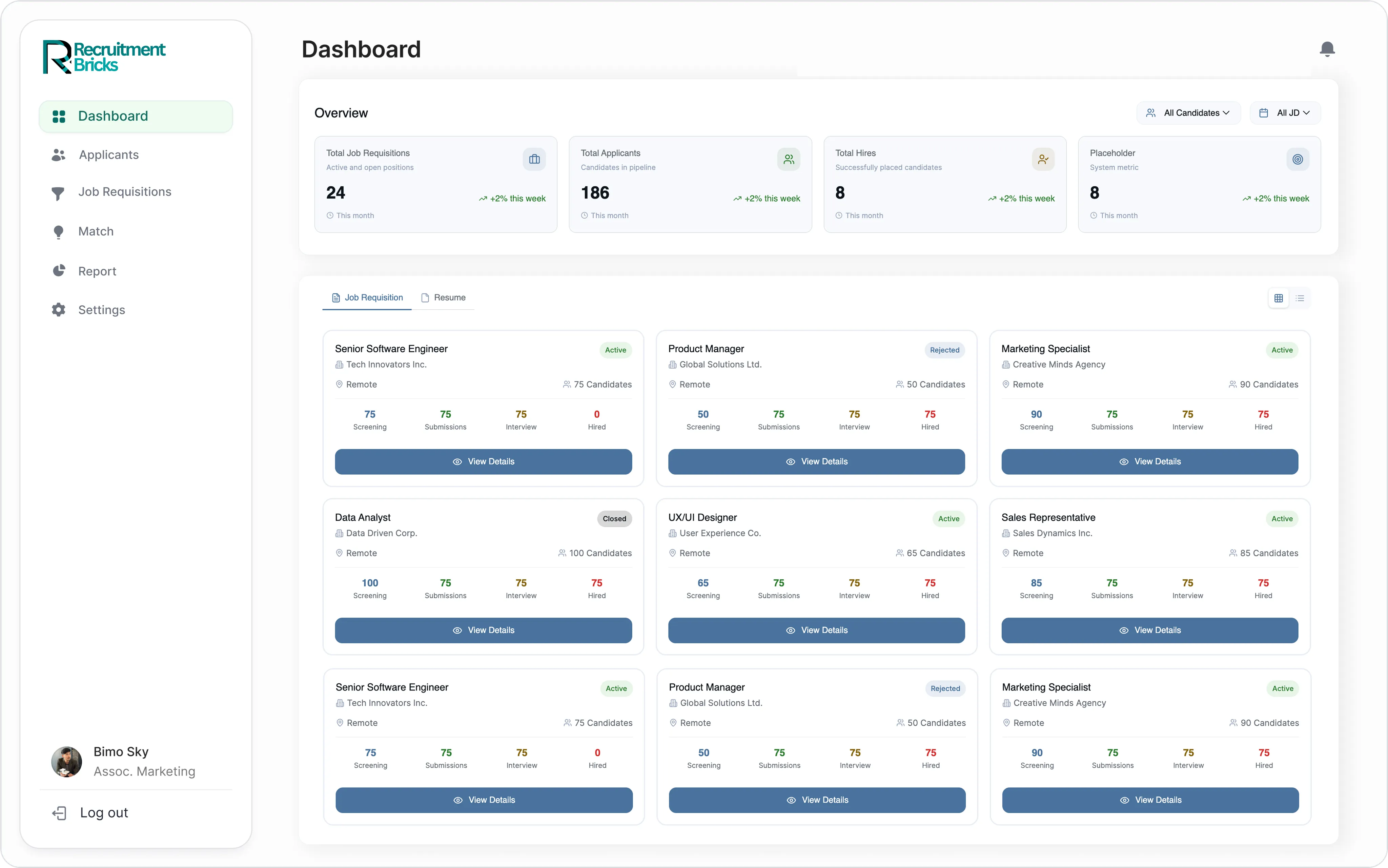
A robust candidate tracking system does more than store applicant data. It gives enterprise recruiters a live view of pipeline health across all open roles. Real-time dashboards show where candidates are in the process, which roles are stalling, and which sourcing channels are delivering the best results. Action-enabled platforms take this a step further by surfacing the 'next best action' for each candidate, so recruiters are never guessing what to do next. This kind of pipeline intelligence is particularly valuable for enterprise teams where multiple recruiters are working simultaneously on overlapping roles. To see how AI recruitment software supports enterprise teams specifically, read AI Recruitment Software for Enterprise Teams: Cut Time-to-Hire Faster.
Internal Mobility and Reverse Resume Matching
Enterprise organizations often overlook their most qualified candidates: the employees already on their payroll. Reverse resume matching solves this by analyzing internal talent profiles against open roles, surfacing employees who are ready to move into new positions. This capability unifies external hiring and internal mobility in a single platform, giving HR leaders a complete view of available talent. It reduces external hiring costs, accelerates time-to-fill for critical roles, and improves employee retention by creating visible growth pathways. For enterprise teams, this feature alone can justify the investment in an AI hiring platform.
Automated Candidate Engagement Across Channels
Candidate experience is a competitive differentiator for enterprise employers. Long gaps between application and response push qualified candidates toward competitors. AI platforms address this with automated WhatsApp outreach, interview scheduling, feedback nudges, and instant follow-ups triggered by pipeline events. These tools keep candidates informed and engaged without adding to recruiter workload. They also ensure that no candidate falls through the cracks because a recruiter was busy with another role. For enterprise teams hiring at scale, automated engagement is not a luxury. It is a necessity.
Integrations: Connecting AI Tools to Your Existing Stack
Enterprise organizations rarely start from scratch. Most have existing HRMS platforms, CRM tools, and legacy ATS solutions already in place. The best AI hiring platforms are designed to integrate with these systems rather than replace them. Seamless integrations ensure that candidate data flows across tools without duplication, and that recruiters can work within familiar interfaces while benefiting from AI-powered insights layered on top.
Platforms that connect natively with tools like Google Workspace, email marketing platforms, and other enterprise software reduce implementation friction significantly. You can review available integration options for enterprise teams at RecruitmentBricks Integrations. When evaluating any AI hiring platform, ask vendors specifically about their integration depth, data sync frequency, and support for custom API connections.
How to Evaluate AI Hiring Platforms for Your Enterprise
Choosing the right platform requires more than reading a feature list. Enterprise recruiters should evaluate AI hiring tools against a structured set of criteria aligned with their specific hiring challenges.
- Bias reduction mechanisms: Does the platform use explainable AI? Are match scores transparent and auditable?
- Screening depth: Does the platform support voice screening, structured scoring, and custom question generation?
- Pipeline visibility: Does the candidate tracking system provide real-time dashboards and next-action recommendations?
- Internal mobility support: Can the platform match open roles to existing employees as well as external applicants?
- Integration flexibility: Does the platform connect with your existing ATS, HRMS, and CRM without heavy custom development?
- Scalability: Can the platform handle high-volume hiring across multiple business units simultaneously?
- Vendor transparency: Does the vendor clearly explain how their AI models work and how bias is managed?
Requesting a live demo is often the best way to assess how well a platform fits your team's workflow. You can schedule a session directly at RecruitmentBricks Request a Demo to see these capabilities in action within a real enterprise hiring context.
The Human Side of AI-Assisted Hiring
A common concern among enterprise HR leaders is that AI will remove the human element from hiring. The best platforms are designed to do the opposite. By automating repetitive, time-consuming tasks like resume screening, scheduling, and follow-up, AI frees recruiters to spend more time on meaningful work: building relationships with candidates, advising hiring managers, and making nuanced judgment calls that no algorithm can replicate.
AI should function as a decision-support tool, not a decision-maker. Explainable scores, structured data, and pipeline intelligence all inform recruiter judgment rather than override it. This philosophy is central to platforms built for enterprise environments, where hiring decisions carry significant organizational weight and must be defensible at every stage.
Conclusion
Enterprise hiring is too complex and too consequential to rely on manual, inconsistent processes. Applicant tracking system AI gives large organizations the tools to screen smarter, move faster, and hire more fairly at every stage of the pipeline. From AI-powered voice screening and explainable match scores to real-time pipeline dashboards and internal mobility support, the right platform can transform how your talent acquisition team operates. If you are ready to modernize your enterprise hiring process, explore the platform capabilities at RecruitmentBricks Features and request a demo to see the platform in action.
FAQ
What is applicant tracking system AI and how does it work?
Applicant tracking system AI uses machine learning to parse resumes, score candidates against job descriptions, and recommend recruiter actions. It automates repetitive screening tasks and delivers explainable match scores to support fairer, faster enterprise hiring decisions.
How does intelligent applicant screening software reduce hiring bias?
Intelligent applicant screening software evaluates every candidate using the same structured criteria, removing inconsistencies introduced by manual review. Explainable AI scores show exactly why a candidate ranks highly, making decisions transparent, auditable, and more defensible for HR teams.
What features should enterprise recruiters look for in the best applicant tracking systems?
The best applicant tracking systems for enterprises include voice screening, explainable AI match scores, real-time pipeline dashboards, internal mobility tools, and seamless integrations with existing HRMS and CRM platforms. Scalability across multiple business units is also a critical evaluation factor.
How does a candidate tracking system improve enterprise pipeline management?
A strong candidate tracking system provides live dashboards showing where every applicant stands across all open roles. It identifies pipeline bottlenecks and surfaces next-action recommendations, helping enterprise recruiting teams stay organized and responsive without missing qualified candidates.
Can AI hiring platforms support internal mobility as well as external hiring?
Yes. Leading AI hiring platforms use reverse resume matching to identify internal employees who qualify for open roles. This unifies external hiring and internal mobility in one workflow, reducing time-to-fill for critical positions and improving employee retention across the organization.
How do AI hiring platforms integrate with existing HR technology stacks?
Most enterprise-grade AI hiring platforms connect with existing ATS, HRMS, and CRM tools through native integrations and APIs. You can review specific integration options at RecruitmentBricks Integrations to understand how the platform connects with your current technology stack.
Does AI in hiring replace human recruiters?
No. AI is designed to assist recruiters, not replace them. By automating screening, scheduling, and follow-up tasks, AI frees recruiters to focus on relationship-building, strategic advising, and nuanced judgment calls that require human experience and contextual understanding throughout the hiring process.
What is VoiceBot screening and why does it matter for enterprise hiring?
VoiceBot screening conducts structured AI-driven voice interviews with candidates and scores their responses automatically. It generates custom questions based on the resume and job description, ensuring consistent evaluation at scale and significantly reducing the time recruiters spend on first-round screening.
How can enterprise teams get started with an AI hiring platform?
The fastest way to evaluate fit is through a live product demo. You can request a demo at RecruitmentBricks to see AI-powered screening, candidate tracking, and pipeline intelligence features demonstrated within a real enterprise hiring workflow.
What makes AI match scores explainable and why does that matter?
Explainable AI match scores break down how a candidate aligns with a job description by skills, experience, and qualifications. This transparency helps recruiters understand recommendations, justify decisions to stakeholders, and catch cases where strong candidates may have been filtered unfairly by formatting issues.